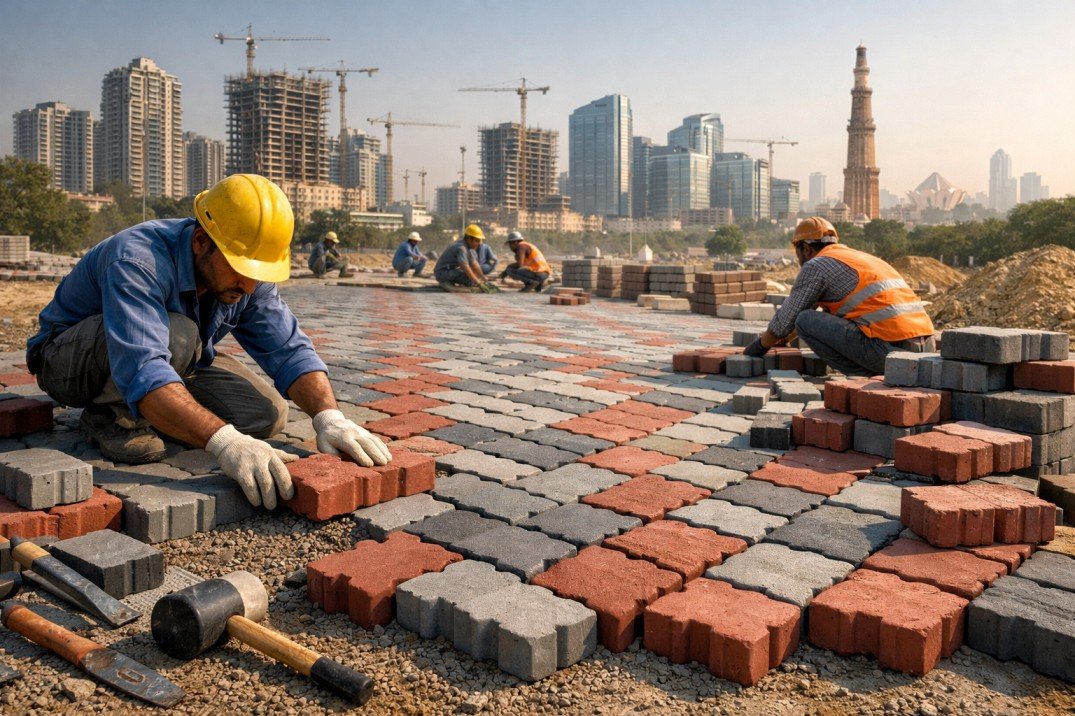
As construction costs rise across Gurgaon, Faridabad, Noida, and Greater Delhi, structural engineers, real estate developers, and individual home builders are turning to smart, mortarless building alternatives. Interlocking bricks have emerged as one of the most efficient, cost-effective, and climate-resilient masonry solutions for modern Indian construction.
Unlike traditional burnt clay bricks or standard fly ash blocks, interlocking bricks utilize a high-precision tongue-and-groove (male-female) locking mechanism. This allows blocks to lock into place cleanly, drastically reducing cement mortar dependency during wall assembly.
Technical Specifications: Interlocking Bricks vs. Traditional Bricks
| Property / Parameter | High-Density Interlocking Bricks | Traditional Burnt Red Clay Bricks |
| Locking Mechanism | Self-aligning Tongue & Groove | Heavy Mortar Joint Required |
| Compressive Strength | 7.5 N/mm² to 15 N/mm² | 3.5 N/mm² to 7.0 N/mm² |
| Mortar Usage | 80–90% Reduction (Thin slurry/dry stack) | High (12mm–15mm mortar bed) |
| Plaster Requirement | Minimal to Nil (Smooth finish ready for putty) | Double Coat (Rough coat + Fine coat) |
| Efflorescence (Shora) | Zero (Salt-free raw material mix) | High (Salt patches destroy paint) |
| Thermal Insulation | Superior (Cavity designs keep interiors cool) | Standard Heat Transfer |
| Construction Speed | Up to 3x Faster | Standard Manual Pacing |
4 Major Reasons to Choose Interlocking Bricks in Delhi NCR
1. Massive Material & Labor Cost Savings
The primary driver behind adopting interlocking brick technology in Gurgaon’s real estate corridor is the total cost reduction per square foot.
-
Zero Plaster Dependency: Because the bricks are manufactured using high-pressure hydraulic presses, their surfaces and edges are perfectly straight. Wall surfaces can be directly painted or finished with a thin skim coat of wall putty.
-
Minimal Cement Consumption: You only require cement slurry or adhesive at every 3rd or 4th layer for stability, cutting sand and cement mortar expenses by up to 80%.
2. High Thermal Insulation for Gurgaon Summers
Summers in Delhi NCR frequently hit temperatures over 42°C. Interlocking concrete and stabilized soil-cement bricks feature internal hollow cavities or dense thermal mass properties. This creates an insulating barrier that reduces heat transfer into your building, lowering your long-term air conditioning power consumption.
3. Faster Execution for High-Rise and Boundary Walls
Because the bricks lock into position like a puzzle, workers do not have to spend hours leveling individual mortar beds. A standard masonry team can construct boundary walls, farmhouse structures, and infill partition walls up to three times faster than traditional bricklaying.
4. Eco-Friendly & RERA-Compliant
Interlocking soil-cement and concrete blocks do not require topsoil destruction or high-carbon kilns to produce. Sourcing these blocks helps projects comply with IGBC (Indian Green Building Council) standards while staying fully RERA-compliant.
Current Price Range in Gurgaon & Delhi NCR
Pricing for interlocking bricks in the NCR market varies based on the raw material base (concrete vs. compressed stabilized earth/soil), dimensions, and density ratings:
-
Cement/Concrete Interlocking Bricks (9" x 4" x 3" or 12" x 6" x 4"): ₹12.00 to ₹35.00 per piece
-
Interlocking Paver & Wall Blocks (60mm / 80mm): ₹14.00 to ₹45.00 per piece (or ₹35.00 to ₹55.00 per sq. ft.)
-
Minimum Order Quantity (MOQ): Standard truckload shipments range between 3,000 to 5,000 pieces.
Primary Applications in NCR Infrastructure
                  [ Interlocking Brick Applications ]
                                   │
       ┌───────────────────────────┼───────────────────────────┐
       ▼                           ▼                           ▼
[ Boundary Walls ]         [ Farmhouses & Villas ]     [ Infill Partition Walls ]
Fast, low-cost perimeter   High aesthetic appeal with  Used in RCC framed structures
walls with zero plaster.   exposed natural finish.     across commercial towers.
-
Boundary Walls & Security Fencing: Ideal for quick installation along large industrial plots in Manesar, Sohna Road, and Kharkhoda.
-
Farmhouses & Luxury Eco-Villas: Gives a modern, rustic "exposed brickwork" aesthetic popular across Chattarpur, Golf Course Extension, and Greater Noida West.
-
Internal Partition Walls: Lightweight hollow-core interlocking blocks reduce dead load weight on multi-story RCC structures.
FAQs
Q1: Are interlocking bricks strong enough for load-bearing walls?
Yes. High-quality interlocking bricks pressed at over 1,500 PSI achieve compressive strengths of 7.5 N/mm² to 15 N/mm². This exceeds the Bureau of Indian Standards (BIS) requirements for Class I structural load-bearing walls up to two stories without needing full RCC framing.
Q2: Do interlocking bricks leak during the Delhi NCR monsoon season?
No. High-density interlocking bricks have lower water absorption rates (under 8% to 10%) compared to red clay bricks (15% to 20%). When the tongue-and-groove joints are assembled with thin-bed adhesive or water-resistant slurry, they form a tight weather seal against driving rain.
Q3: Where can I source bulk interlocking bricks near Gurgaon?
Bulk interlocking bricks are available direct-from-factory across major supplier hubs along Sohna Road, Sector 67 (M3M Urbana), Pataudi Road, and Sonepat/Faridabad industrial zones for direct truckload site delivery.
Q4: How do interlocking bricks lower wall construction cost per square foot?
While the upfront price per individual block may be slightly higher than standard bricks, interlocking bricks eliminate almost all cement-sand mortar, speed up labor time by 300%, and remove the need for rough wall plaster—yielding a 20% to 35% net savings on finished walls.